To most and almost every other intent you may think or conceive of and in all the wishes and dreams you manifest, they all begin with a mutual presence you share in sense and mutual relevance.
The expression that manifest may often result in seemingly random patterns for all intent and purpose but what we expect which often lead to the self deprecating view that 'life is a bitch', and 'luck be the lady' you wine and dine if you want any return on your vested presence.
The truth of the matter is that Nature provides serendipitous reward for the sheer sake of playing in the flow of confluence and sharing in the mutual interest of living life well and well aware.
This adds to a large body of evidence that plants have a variety of higher level mental processes that include affinity, awareness, the ability to feel fear and experience happiness.
Plants are able to share information about their environment between seed and saplings, they can communicate via chemical signals with other plants, and interact with other bio-physical entities through various means that include pheromones, color signals, and quantum entanglement.
The proof of these extra ordinary capabilities of plants coincide with the invention of the Lie Detector Test. Extensively documented by the inventor who noticed how his office plant responded to emerging and intentended environmental threat. The proof of his astounding find was never seriously considered by the scientific community of his day, and yet his findings has never been refuted.
Much as with many a visionary in history the notion of plants able to have any feeling, being aware, and communicating with anther was once deemed too bizarre to believe at the time. But times are changing, and in light of quantum proof that what he observed is quite common in plants, maybe its time we start to notice the truth about us, about plants, and the meaning of life.
A recent scientific study aimed to investigate how beliefs polarized attitudes toward newly emerging research topics are raising some interesting questions about belief and provide clear and present evidence of high levels of cognitive dissonance, particularly among the devout and politically conservative participants.
The Polarization increased in the higher educated sample of conservative believers, that support the evidence of cognitive dissonance that confirm the nature of the insipid affliction, and expand our woeful lack of evidence about the pathogenesis of a mental disease that undermine and usurp our sanity in every sense imaginable.
Though dissonance is never mentioned by the researchers as probable cause, the evdice is conclusive. Alarmingly so if you look at it without any bias or preconception. A summary of their findings are as follow:
The researchers found little evidence of political or religious polarization for nanotechnology and genetically modified food.
The opposite was found with stem cell research, the big bang theory, and evolution. On each of these issues, individuals with higher education, science education and literacy had more polarized beliefs.
Although the evidence clearly support the notion of cognitive dissonance, the researchers conclude that further research is needed to determine the reason.
From my point of view it seems the only way that we can benefit from most of the research done these days, is to evaluate the findings from a shared perspective. That is, if we had the means to do so.
And dare we not, do we continue to hold science accountable for what we believe, or take a leap of faith and rise above our beliefs to see the world without any bias, confabulation or misconception.
Feeling good is the tip of the iceberg to the feeling of being in flow. On a scale of all human experience it doesn't beat extacy, but then again extacy is not a physiologically sustainable experience, whereas flow is. Imminently so.
By its nature reality doesn't as much beat around the bush as bash you over the head. Nothing to do with you, but it often hurts if it hits you head on.
Flow is the resonance of relevance we share
Nothing shared, nothing gained the wisdom goes.
What goes around come around they say and they are right. Perhaps not because they believe it but because its hard not to notice.
Not that it's any of my business you see, and as for the rest of the universe it doesn't much matter what you may think or believe. You see what you do, presume what you know or understand, but in the Grand Scheme of Things you are irrelevant, and what you see or feel or know in your head or your heart to be true is irreverant in light of a conscious aware, much less if it's not shared in the mutual relevance of resonance
or become in the present sense of mutual flow and shared intent.
The universe don't care about the you you don't have, or the feelings you bide in the guilt of your shame and your private remorse. The universe don't mind what you matter you see, and leaves that up to you you want to be you see.
The dogma of belief you claim is as insignificant as the truth of your bias, the value of your esteem, the worth of your need, the moral you heed, the reality you claim to percieve, the rights or respect you bequeath, your depths of prevation, hope for salvation, wrath or divine intervention you fear.
Given the nature of the universe, the resonance of relevance in harmony to shared intent, the present sense we share in mutual presence, the perspective we share in aware, and the knowing we have of how it feels and what feels good its a foregone conclusion.
There is no sense in arguing, much less if you mind the limited logic your'e left with under such conditions of stess, to vasalate about what you see as threat to your survival, cocacenate about the loss of sense, or pense on the lack of integrity to your reality. The universe don't care about your lack of reason, loss of mind or lucidity, you see.
As sacrosant is to belief, the nature of the universe flow forth the way it has before the minds of (wo)men portend significance and will so hence for ever more and its up to you you see. To join in the wonder of its awe, bask in the wade of its glory, or join the amaze of its journey become.
According to Uberfacts, when all the various scientific claims for improving longevity are fed into one database, you gain two extra years by flossing every night and three years by having more than three orgasms a week.
None of which will matter when the world ends on 21 December this year which according to Time Magazine is nothing but a load of Pakal's bloated ego, and certainly nothing like the mystical document of predict, and predeliction some people would have it to be. Pakal the Great (603-683 A.D.) was the most important ruler of the classical Maya, and there seem to be evidence that suggests the king and his court manipulated the timelines of Mayan cosmology in order to turn his birth date into a divine milestone.
Not that divine milestones were that strange, but the birth days of the great prophets and kings of antiquity preferred to assign the importance of their arrival to an important sign in the stars or natural event rather than dates, but to the Mayans, who were generally known as obsessive compulsive about time, I suppose it makes for a
heratage
of portent .
"One goal of the Maya calendar keepers," the investigators write, "was to seek harmony between sky events and sacred rituals."
What Time doesn't mention is that the Mayan's not only developed the calander, they also prepared a complete set of prophesies, predictions, revelations, tips and general advice on every cycle of every cycle of every cycle they dated.
If I was even the slightest bit paranoid about the abuse of power by the media, I would probably have expected Time to deny the end of days. Lucky I'm not, which doesn't stop me from planning a party worthy of the end, up to and including a no-money-back-guarentee sunrise breakfast looking out of God's Window, and in to the future of a world we create for our self.
One of the most satisfying experiences of being aware is sharing it, and mankind has always found common ground through the rhythms we share beyond the diaspora that we made in diversity.
In the same way drum circles bond us beyond our ancestry, the modern rhythms of hip-hop and trance, and even the non-rhythm of rap and chant are all powerful reminders that mankind share as much in the rhythm of nature's beat as the chirp of a bird, the rattle of a snake, or the awareness piercing sound that a cricket would make.
By it's very nature I suppose it's no surprise that people in general should think that drums and rhythm would be the key elements at play in a drumming circle, but as those who still brave the star studded theater of sound would attest it's much, much more than just that. If we dig deep in the depths of our collective awareness, we'll all probably end up with the same point of view that I first heard about in a Shaman's tale.
A tale of symbols and fire and rhythm and chant, of dancers that sway in hypnotic refrain. Of pulses and pattern and a harmony created by all the elements we bring to the fray. Elements that resonate in the truth of our intention, reward us in measure to the worth that we bring, and leave in it's wake the profound knowledge of a bond we share in ritual, and an awareness of the harmony that is, and a feeling of elation that we can be part of wherever we want, whenever we choose.
Words out and The Avengers will be entertaining us with yet another breath catching, mind boggling, death defying, popular culture eye-opener big screen episodes of awe inspiring action.
And seeing that Superhero's will be assaulting our sensibility once more I thought it about time that we open the box of diaspora and see if we couldn't come up with a more reality relevant sort of hero.
Please submit me your suggestion below, or read through the plentiful suggestion of others to inspire your own.
A research perspective on something as magnificently austere as being in the presence of the divine may sound like it belongs in Alice’s Wonderland, and yet you'd be surprised as she to believe everything that we put up with in the interest of belong. More often before the altar of Mammon than the divine I fear.
Still I am, in direct contrast to afraid I'm mindfully aware, less inclined to think, more inspired to be, and perfectly aligned with the need of others than my own. The more I know about flow the less I need to believe. If you'd like to know more please read the article on my blog Serendipity.
Well, they are going to have a debate over it. The answer may determine the fate of enlightenment for the future of mankind and the question is do you, or don't you support the use of connectomics. Better yet do you, or don't you think you become who you are.
Does, or doesn't it add value to painstakingly trace the path of an existence over time if the resources required are vast?
The debate I bet will be valuable to observe since it has been more than a lifetime of coming to a point that we have enough knowledge on the mind to have one!
I look forward to witnessing the public challenge between these two formiddable proponents as they debate on an organ we thought were 10% thinking, 90% cushy comfort. .
<<90% of the brain are glial cells, and according to a recently published interview with the author of The root of thought, neurons are important too! They are the strings that connectomics hope to tie down to map the way that our mind works, watching in awe of making sense from the wired connections they trace in our brain.>>
Or why "Tell me why I don't like Mondays" has more to do with what's going on in our head than what happens Monday morning in bed?
We humans have a complicated and ambivalent relationship to pleasure, which we spend an enormous amount of time and resources pursuing. A key motivator of our lives, pleasure is central to learning, for we must find things like food, water, and sex rewarding in order to survive and pass our genetic material to the next generation. Certain forms of pleasure are accorded special status. Many of our most important rituals involving prayer, music, dance, and meditation produce a kind of transcendent pleasure that has become deeply ingrained in human cultural practice.
According to David J. Linden, professor of neuroscience at the Johns Hopkins University School of Medicine, chief editor of the Journal of Neurophysiologyand Author of the book The Compass of Pleasure, for us humans (and probably for other primates and for cetaceans as well), even mere ideas can activate the pleasure circuit. Our eclecticism where pleasure is concerned serves to make our human existence wonderfully rich and complex.
Evolution has, in effect, hardwired us to catch a pleasure buzz from a wide variety of experiences from crack to cannabis, from meditation to masturbation, from Bordeaux to beef.
According to all sources, feeling good is the reason why we do just about everything, and the reason we do is the same for bonding, cuddling, orgasm, play, altruism, addiction, or every sinful pleasure we dare imagine. Oxytocin, or more precise the lack of it is on it's own the sole and only cause for most of our modern day dreary and blues.
Best known for it's role in sexual production and often referred to as the love hormone, oxytocin is a neuropeptide, and together with vasopressin the only known hormones excreted by the posterior pituary gland with an impact on distal organs and systems, but much more common in direct response to anything that make us feel good.
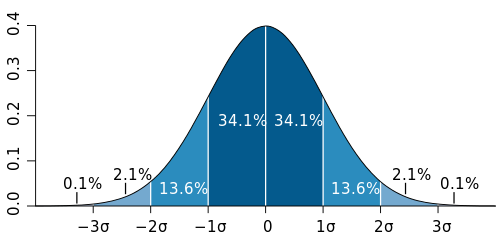
It's role in addiction is best understood in view of the genetic variations that exist between people which is believed to result in a chronic deficiency. All individuals that fall below the normal distribution of a standard bell curve would in all probability be oxytocin deficient, and therefore be prone to addictive behaviour. Behaviour that made the Boomtown Rats song famous for asking why we hate Monday's.
Because 5 day work weeks aren't nice, that's why!
Dark blue is less than one standard deviation from the mean. For the normal distribution, this accounts for about 68% of the set, while two standard deviations from the mean (medium and dark blue) account for about 95%, and three standard deviations (light, medium, and dark blue) account for about 99.7%
With research finding more and more clues about the power of our mood, and the recent development of fRMI turning our understanding of the mind on its head, I guess it should come as no surprise that the value of happiness be questioned.
I can understand why, but that does not detract from my amusement at the fact that a significant number of scientists seem to be involved in a campaign that question the value of happiness. With the discovery that happiness is a choice more often than not, that happy people are less interested in things like financial markets, news or advertisements I guess it's no surprise.
"a wealth of data suggesting that being happy isn't all it's cracked up to be. In previous studies, Forgas has found that happy people are less able to develop a persuasive argument, more gullible and worse at remembering objects in a shop window than their unhappy fellows."
By the look of it these prophets of doom and gloom are fighting dirty as well, since the article goes on to mention that "in another study, happy non-Muslim Australians were more likely to make snap negative judgments about – and even to shoot – computer images of people in traditional Muslim dress."
Being a South African I cannot claim to have any understanding of relationships between Muslim and non-Muslim Australians, but citing happy Australians taking pot-shots at people dressed like Muslims doesn't sound like happy to me in the least.
With speculation rife about what's it all about, what is want and what is meant, what is value and what worth, I'd suggest you give the chance a choice. The worst that could happen is you're back where you are right now. Think about what you gain.
Word is out, and its happiness. Nothing more than a choice, nothing less than a life-changing event. You can try it any time you want. If you don't like it you can always change your mind. Set a reminder if you want.
From personal experience it is something I highly recommend.
Religion is often suggested as a by product of mans' morality or as a tool towards power. In the article How did religion evolve?, World Science argue that religion is most likely something that developed from existing human ability.
"... past studies, the authors said, show that people of differing religion or no religion show similar moral judgments when asked to comment on unfamiliar moral dilemmas. That suggests intuitive judgments of right and wrong work independently of explicit religious commitments, the researchers argued."
This supports the theory that religion... evolved as a separate by-product of preexisting cognitive functions that evolved from non-religious functions!
I have recently been reminded that the global distribution of domesticated animals during the time of the Spanish Conquistadors was responsible for the presence of smallpox among their invasion of the America's. It made me look up the global distribution of blood groups, and the following information:
The majority of the people in the world have the Rh+ blood type. However, it is more common in some regions. Native Americans and Australian Aborigines were very likely 100% Rh+ before they began interbreeding with people from other parts of the world. This does not imply that Native Americans and Australian Aborigines are historically closely related to each other. Most African populations are around 75% Rh+. Europeans have the lowest frequency of this blood type for any continent. They are 60% Rh+. The lowest known frequency is found among the Basques of the Pyrenees Mountains between France and Spain. They are only 47% Rh+.
If there is a single observation that seem to remain a popular feature of the change associated with growth and development it would probably have to do something with popular belief. It never cease to amaze me how often popular belief contain some of the most recent scientific discoveries as part and parcel of allegory, myth and mysticism, or how wrong popular belief can sometimes be. Take for instance our recently discovered knowledge with regard to awareness.
Over the past few years we have discovered some amazing new facts about how our minds synthesize reality from the sensory information that it receives from the brain. I have previously written various articles that focus on how sensory information is utilised to establish patterns, and how the brain then switches to auto-pilot. This allows the brain to free a substantial amount of processing power, with sensory input being limited to the detection of unexpected events.
In a report on Auditory illusion: How our brains can fill in the gaps to create continuous sound, Science Daily discusses research that propose our auditory sensory system have a similar ability that allow us to reconstruct fragmented sounds in to a coherent stream of information, all in aid of achieving a representation of reality that make sense. According to Science daily: "It is relatively common for listeners to 'hear' sounds that are not really there. In fact, it is the brain's ability to reconstruct fragmented sounds that allows us to successfully carry on a conversation in a noisy room."
Not only does it confirm something that we have observed with visual sensory information, but the research go further to help explain what happens in the brain that allows us to perceive a physically interrupted sound as being continuous. The research, published by Cell Press in the November 25 issue of Neuron provides fascinating insight into the constructive nature of human hearing, and could provide us with clues as to how our visual sense is translated to awareness.
It would seem that we are slowly but surely starting to make sense of our senses, and with that we are starting to understand how we make sense of the world around us.