Thursday
The Entrainment of Happiness
Friday
In defence of casual sex
| Those of us who have casual sex know that its not devoid of emotion, nor does it lead to the unhappiness that is laid to it's blame. Society dictates that only within marriage or another long-term relationship do sex and intimacy exist and popular culture upholds this as the ultimate formula for happiness. Despite the high divorce rate, tax laws, for example, continue to bestow benefits on married couples, while relegating single people to second-class status. via In Defense of Casual Sex | Psychology Today |
Divine (even mad) shortcuts
I'd love the hear what you think?
Wednesday
The pleasure of feeling good...
We humans have a complicated and ambivalent relationship to pleasure, which we spend an enormous amount of time and resources pursuing. A key motivator of our lives, pleasure is central to learning, for we must find things like food, water, and sex rewarding in order to survive and pass our genetic material to the next generation. Certain forms of pleasure are accorded special status. Many of our most important rituals involving prayer, music, dance, and meditation produce a kind of transcendent pleasure that has become deeply ingrained in human cultural practice.
Evolution has, in effect, hardwired us to catch a pleasure buzz from a wide variety of experiences from crack to cannabis, from meditation to masturbation, from Bordeaux to beef.According to all sources, feeling good is the reason why we do just about everything, and the reason we do is the same for bonding, cuddling, orgasm, play, altruism, addiction, or every sinful pleasure we dare imagine. Oxytocin, or more precise the lack of it is on it's own the sole and only cause for most of our modern day dreary and blues.
Best known for it's role in sexual production and often referred to as the love hormone, oxytocin is a neuropeptide, and together with vasopressin the only known hormones excreted by the posterior pituary gland with an impact on distal organs and systems, but much more common in direct response to anything that make us feel good.
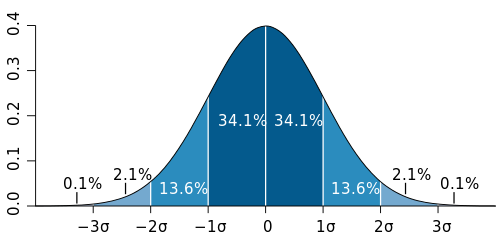
It's role in addiction is best understood in view of the genetic variations that exist between people which is believed to result in a chronic deficiency. All individuals that fall below the normal distribution of a standard bell curve would in all probability be oxytocin deficient, and therefore be prone to addictive behaviour. Behaviour that made the Boomtown Rats song famous for asking why we hate Monday's.
Because 5 day work weeks aren't nice, that's why!
| Dark blue is less than one standard deviation from the mean. For the normal distribution, this accounts for about 68% of the set, while two standard deviations from the mean (medium and dark blue) account for about 95%, and three standard deviations (light, medium, and dark blue) account for about 99.7% |
RU losing your mind?
In some of the more encouraging scientific discoveries from recent years it's suggested that our mental ability could be saved from the rising incidence of senility by using it!
At first it seemed as if certain mental activities worked better than others, but as research continued we found that our brain adapt to just about anything we put our mind to, even if it means rewiring a part of the brain, as is commonly found in people learning to use cellphones for the first time.
I suppose it is easy to see how our morbid fear of getting old turned fact into the general belief that the brain is a like a muscle that can be exercised to save ourself from the permanent loss of faculty and reason, or even worse to drifting off slowly to the land forgot and in to the obscurity of Alzheimer's disease...
Easy too to understand the all too eager helping hand of those who saw a market gap, and before you could say snap had just the remedy to guarantee a mental clarity and agility you last had as a teen. It's an assumption that has spawned the multi-million-dollar computer-game industry of electronic brainteasers and memory game. But according to the research findings of a recently published paper it seems that the assumption could be wrong. According to the article in TIME:
in the largest study of these games to date, a team of British researchers has found that healthy adults who undertake computer-based "brain training" do not improve their mental fitness in any significant way.As you may expect, the research was immediately met with a barrage of doubt and disbelief, particularly from companies that make a lot of money with all kinds of mind enhancing schemes.
It remains to be seen who will win the battle for our sanity, but to me it seems a review of the facts on hand suffice what we have always known as true, not only of our mind, but nature all around.
Tuesday
Babies need tummy time!
Take the recent findings on the relation between tummy time and developmental milestones as a good example (According to research, the time that babies spend playing around on their tummies is pivotal to a whole range of skills), or the discovery of below average executive functions when babies are turned on their back when they sleep.
It seemed like a good idea at the time. With crib deaths were on the rise, and statistical evidence backing up the apparent common sense that babies sleeping on their tummy are at risk, it wasn't long before Pediatric Specialists all over the world were urging mothers to turn their toddlers in the interest of preventing crib death.
And so began a growing trend of babies that are slower than tummy toddlers who have higher IQ's at 8, higher reading comprehension by the age of 26, and according to the recent finding of a long term follow-up and comparison study, by the time they hit their 30's tummy toddlers have a higher level of education and generally score better in executive functions such as categorization than babies raised on their back.
You can find the original article with links to the scientific research by following the link below:
Why babies need more tummy time than they're getting. - By Brian Mossop - Slate Magazine
Sunday
It's a small world after all!
"This is a milestone," says Wojciech Zurek, a theorist at the Los Alamos National Laboratory in New Mexico. "It confirms what many of us believe, but some continue to resist—that our universe is 'quantum to the core'."Macro-Weirdness: "Quantum Microphone" Puts Naked-Eye Object in 2 Places at Once: Scientific American
Saturday
To be, or not to be happy
With research finding more and more clues about the power of our mood, and the recent development of fRMI turning our understanding of the mind on its head, I guess it should come as no surprise that the value of happiness be questioned.
I can understand why, but that does not detract from my amusement at the fact that a significant number of scientists seem to be involved in a campaign that question the value of happiness. With the discovery that happiness is a choice more often than not, that happy people are less interested in things like financial markets, news or advertisements I guess it's no surprise.
According to the article in New Scientist called Happiness ain't all it's cracked up to be:
"a wealth of data suggesting that being happy isn't all it's cracked up to be. In previous studies, Forgas has found that happy people are less able to develop a persuasive argument, more gullible and worse at remembering objects in a shop window than their unhappy fellows."By the look of it these prophets of doom and gloom are fighting dirty as well, since the article goes on to mention that "in another study, happy non-Muslim Australians were more likely to make snap negative judgments about – and even to shoot – computer images of people in traditional Muslim dress."
Being a South African I cannot claim to have any understanding of relationships between Muslim and non-Muslim Australians, but citing happy Australians taking pot-shots at people dressed like Muslims doesn't sound like happy to me in the least.
With speculation rife about what's it all about, what is want and what is meant, what is value and what worth, I'd suggest you give the chance a choice. The worst that could happen is you're back where you are right now. Think about what you gain.
Word is out, and its happiness. Nothing more than a choice, nothing less than a life-changing event. You can try it any time you want. If you don't like it you can always change your mind. Set a reminder if you want.
From personal experience it is something I highly recommend.
Tuesday
Non-racial global distribution patterns
Modern Human Variation: Distribution of Blood Types
The majority of the people in the world have the Rh+ blood type. However, it is more common in some regions. Native Americans and Australian Aborigines were very likely 100% Rh+ before they began interbreeding with people from other parts of the world. This does not imply that Native Americans and Australian Aborigines are historically closely related to each other. Most African populations are around 75% Rh+. Europeans have the lowest frequency of this blood type for any continent. They are 60% Rh+. The lowest known frequency is found among the Basques of the Pyrenees Mountains between France and Spain. They are only 47% Rh+.
Saturday
Whats up with that?
Take for instance the saying, "Happy people are short sighted." Not only is it true that happy people are like that, but it is true in reality. Grumpy people are better at observing the distant features, and their logical thinking ability is better than their happy counterparts. But then I suppose we have to remember that happiness is what happiness does, and the whole business of business does not really feature in the happy world, which for some or another lack of reason seem to bother those that are grumpy. And lack of reason would be a perfect description of happiness, which provide the perfect reason not to be. Because it is.
And now science can prove it!
Friday
Contrary to popular belief...
Over the past few years we have discovered some amazing new facts about how our minds synthesize reality from the sensory information that it receives from the brain. I have previously written various articles that focus on how sensory information is utilised to establish patterns, and how the brain then switches to auto-pilot. This allows the brain to free a substantial amount of processing power, with sensory input being limited to the detection of unexpected events.
In a report on Auditory illusion: How our brains can fill in the gaps to create continuous sound, Science Daily discusses research that propose our auditory sensory system have a similar ability that allow us to reconstruct fragmented sounds in to a coherent stream of information, all in aid of achieving a representation of reality that make sense. According to Science daily: "It is relatively common for listeners to 'hear' sounds that are not really there. In fact, it is the brain's ability to reconstruct fragmented sounds that allows us to successfully carry on a conversation in a noisy room."
Not only does it confirm something that we have observed with visual sensory information, but the research go further to help explain what happens in the brain that allows us to perceive a physically interrupted sound as being continuous. The research, published by Cell Press in the November 25 issue of Neuron provides fascinating insight into the constructive nature of human hearing, and could provide us with clues as to how our visual sense is translated to awareness.
It would seem that we are slowly but surely starting to make sense of our senses, and with that we are starting to understand how we make sense of the world around us.
Thursday
Devil inside
Only now, with the scientific data to back us we don't have to rely on recalling the examples of history. Now we can quote research! Man, I love those guys and gals in white!
You can read the scientific lowdown on it at World Science.
Saturday
Looking for the devil inside
A new brain imaging study by Josh Greene and Joe Paxton at Harvard University published in the Proceedings of the National Academy of Sciences suggests that what separates the well-behaved from the poorly-behaved might not be the ability to control your temptations but rather what kind of temptations you have.
The study looked at two hypothesis, one in which will is used to suppress the temptation to lie or cheat, and the other where grace was the reason they didn’t.
It’s all very interesting stuff, not the least their finding that demonstrate the human capacity to, at least temporarily, achieve a state of “moral grace” – a state devoid of selfish temptation. I take it there’s no devil then, yes?
Copy suicides – from the world of Opera
Suicide in the case of life without honor, the "Madame Butterfly Effect," is a theme in opera. Persons who are drawn into and/or influenced by the opera subculture of honor are hypothesized to be more accepting of suicide in the case of dishonor to one's family.
Turns out the hypothesis is true, and they are! Imagine that!
Friday
Discovering signs of the self
It turns out that there is a similar pattern of neural activity each time we become conscious of the same picture, but not if we process information from the image unconsciously. These contrasting patterns of activity can now be detected via brain scans, and could one day help determine if patients with brain damage are conscious. They might even be used to probe consciousness in animals.