
On the edge of your vision as you read this, the water swirls but the starfish turns in the other direction, floating above the background.
The image itself is, of course, still: the movement is created in your head. It uses the phenomenon of periphery drift to make us see movement where there is none. The different contrasts between the colours are the key to making us see the star and the background move in opposite directions.
This image was created by Kaia Nao, an alternative identity for wildlife painter Joe Hautman. It is a finalist in the 2012 Best Illusion of the Year Contest, run by the Neural Correlate Society to encourage and publicise the work of researchers in the field of visual illusions. See the winning video in our New Scientist TV post "Best illusion of 2012: The disappearing hand trick".

Showing posts with label understanding. Show all posts
Showing posts with label understanding. Show all posts
Tuesday
Best Illusion 2012
Short Sharp Science: Best illusion of 2012: Floating star drifts into final

Time says its not going to end...
According to Uberfacts, when all the various scientific claims for improving longevity are fed into one database, you gain two extra years by flossing every night and three years by having more than three orgasms a week.
None of which will matter when the world ends on 21 December this year which according to Time Magazine is nothing but a load of Pakal's bloated ego, and certainly nothing like the mystical document of predict, and predeliction some people would have it to be. Pakal the Great (603-683 A.D.) was the most important ruler of the classical Maya, and there seem to be evidence that suggests the king and his court manipulated the timelines of Mayan cosmology in order to turn his birth date into a divine milestone.
Not that divine milestones were that strange, but the birth days of the great prophets and kings of antiquity preferred to assign the importance of their arrival to an important sign in the stars or natural event rather than dates, but to the Mayans, who were generally known as obsessive compulsive about time, I suppose it makes for a heratage of portent .
What Time doesn't mention is that the Mayan's not only developed the calander, they also prepared a complete set of prophesies, predictions, revelations, tips and general advice on every cycle of every cycle of every cycle they dated.

If I was even the slightest bit paranoid about the abuse of power by the media, I would probably have expected Time to deny the end of days. Lucky I'm not, which doesn't stop me from planning a party worthy of the end, up to and including a no-money-back-guarentee sunrise breakfast looking out of God's Window, and in to the future of a world we create for our self.
Much like last year I guess.

None of which will matter when the world ends on 21 December this year which according to Time Magazine is nothing but a load of Pakal's bloated ego, and certainly nothing like the mystical document of predict, and predeliction some people would have it to be. Pakal the Great (603-683 A.D.) was the most important ruler of the classical Maya, and there seem to be evidence that suggests the king and his court manipulated the timelines of Mayan cosmology in order to turn his birth date into a divine milestone.
Not that divine milestones were that strange, but the birth days of the great prophets and kings of antiquity preferred to assign the importance of their arrival to an important sign in the stars or natural event rather than dates, but to the Mayans, who were generally known as obsessive compulsive about time, I suppose it makes for a heratage of portent .
"One goal of the Maya calendar keepers," the investigators write, "was to seek harmony between sky events and sacred rituals."

If I was even the slightest bit paranoid about the abuse of power by the media, I would probably have expected Time to deny the end of days. Lucky I'm not, which doesn't stop me from planning a party worthy of the end, up to and including a no-money-back-guarentee sunrise breakfast looking out of God's Window, and in to the future of a world we create for our self.
Much like last year I guess.
Wednesday
7's not enough (Sins of Course)

... research has shown that self-restraint is like a muscle – the more you use it, the stronger it gets. But it’s also a finite resource. On any given day, if you exert self-control in one situation you’ll have less left over to triumph over temptation later on. ‘Human beings are animals who have managed to create a new kind of social system,’ says Baumeister. ‘The system (culture) requires them to overcome some of their natural, animal habits, inclinations, and tendencies, so as to follow the rules that enable the system to make life better for everyone. Self-control is a vital faculty for enabling them to accomplish this.If you want you can download the full artlicle here if you would like to enjoy his fascinating discussion to include such bespoke irreverence as:
"Seven New Deadly Sins", (I know! Isn't seven enough?) "Seven Evidenced Based Ways To Be Good" (with such gems of modern day goodness as ."If at first you don’t succeed, cheat."), and seven days of confesion by the bloggers at the Psychologist.org.
Thursday
Are you suffering from empty thoughts?
Do you find yourself distracted from the present because you spend most of your mind in mental gridlock? Does your life feel like a rat race without reason or reward? Chances are you're suffering from repetitive thoughts.
 In an atricle by Sophia Dembling over at PsychCentral quote a 2008 literature review of different sorts of repetitive thoughts such as:
And if you were wondering what would constitute the opposite of the various distractions mentioned you should read The perception of consciousness. Let me know what you think.

- Depressive rumination–thinking about your own depression and how it’s messing with your life
- Rumination—thinking about anything over and over, even when it’s not relevant to the moment at hand
- Worry—thinking about something that might end badly
- Perseverative cognition—thinking about something stressful, causing stress responses in your body
- Cognitive and emotional processing—thinking about a stressor and how to integrate it into your life and worldview
- Planning, Problem Solving, and Mental Simulation—planning stuff, figuring stuff out
- Counterfactual thinking—thinking about how you might have done things differently in a past event
- Defensive pessimism—thinking about worst-case scenarios to figure out how they can be prevented
- Reflection—thinking philosophically about who you are, in a way that enhances self-knowledge
- Mind wandering—letting your mind drift from the current task to “internal information”
- Post-event rumination—i.e. thinking about the dumb things you said last night
- Positive rumination—thinking about all the ways you’re awesome
- Habitual negative self-thinking—thinking (uncontrollably) about all the ways you’re a loser
And if you were wondering what would constitute the opposite of the various distractions mentioned you should read The perception of consciousness. Let me know what you think.
Friday
Word of the day: Largess
SexTutor.com has more than just toys on offer, and if you'll pardon a tounge in cheek remark I'd like to quote a spoof as proof~

How to truly fly the friendly skies: To initiate a hand job, unzip the fly of the passenger seated immediately next to you, freeing his penis. Grasping the shaft firmly, use a brisk up-and-down motion until climax is achieved. Flight attendants may provide moist towelettes for cleanup. Hot towels are available to our first-class passengers.

Divine (even mad) shortcuts

Still I am, in direct contrast to afraid I'm mindfully aware, less inclined to think, more inspired to be, and perfectly aligned with the need of others than my own. The more I know about flow the less I need to believe. If you'd like to know more please read the article on my blog Serendipity.
I'd love the hear what you think?
Wednesday
The pleasure of feeling good...
Or why "Tell me why I don't like Mondays" has more to do with what's going on in our head than what happens Monday morning in bed?
 According to David J. Linden, professor of neuroscience at the Johns Hopkins University School of Medicine, chief editor of the Journal of Neurophysiology and Author of the book The Compass of Pleasure, for us humans (and probably for other primates and for cetaceans as well), even mere ideas can activate the pleasure circuit. Our eclecticism where pleasure is concerned serves to make our human existence wonderfully rich and complex.
Best known for it's role in sexual production and often referred to as the love hormone, oxytocin is a neuropeptide, and together with vasopressin the only known hormones excreted by the posterior pituary gland with an impact on distal organs and systems, but much more common in direct response to anything that make us feel good.
It's role in addiction is best understood in view of the genetic variations that exist between people which is believed to result in a chronic deficiency. All individuals that fall below the normal distribution of a standard bell curve would in all probability be oxytocin deficient, and therefore be prone to addictive behaviour. Behaviour that made the Boomtown Rats song famous for asking why we hate Monday's.
Because 5 day work weeks aren't nice, that's why!
We humans have a complicated and ambivalent relationship to pleasure, which we spend an enormous amount of time and resources pursuing. A key motivator of our lives, pleasure is central to learning, for we must find things like food, water, and sex rewarding in order to survive and pass our genetic material to the next generation. Certain forms of pleasure are accorded special status. Many of our most important rituals involving prayer, music, dance, and meditation produce a kind of transcendent pleasure that has become deeply ingrained in human cultural practice.
According to David J. Linden, professor of neuroscience at the Johns Hopkins University School of Medicine, chief editor of the Journal of Neurophysiology and Author of the book The Compass of Pleasure, for us humans (and probably for other primates and for cetaceans as well), even mere ideas can activate the pleasure circuit. Our eclecticism where pleasure is concerned serves to make our human existence wonderfully rich and complex.Evolution has, in effect, hardwired us to catch a pleasure buzz from a wide variety of experiences from crack to cannabis, from meditation to masturbation, from Bordeaux to beef.According to all sources, feeling good is the reason why we do just about everything, and the reason we do is the same for bonding, cuddling, orgasm, play, altruism, addiction, or every sinful pleasure we dare imagine. Oxytocin, or more precise the lack of it is on it's own the sole and only cause for most of our modern day dreary and blues.
Best known for it's role in sexual production and often referred to as the love hormone, oxytocin is a neuropeptide, and together with vasopressin the only known hormones excreted by the posterior pituary gland with an impact on distal organs and systems, but much more common in direct response to anything that make us feel good.
It's role in addiction is best understood in view of the genetic variations that exist between people which is believed to result in a chronic deficiency. All individuals that fall below the normal distribution of a standard bell curve would in all probability be oxytocin deficient, and therefore be prone to addictive behaviour. Behaviour that made the Boomtown Rats song famous for asking why we hate Monday's.
Because 5 day work weeks aren't nice, that's why!
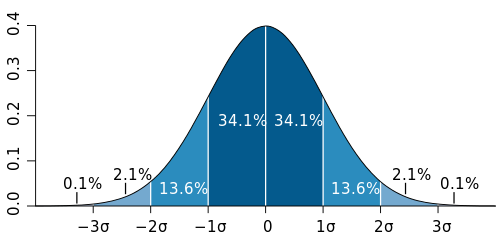 |
| Dark blue is less than one standard deviation from the mean. For the normal distribution, this accounts for about 68% of the set, while two standard deviations from the mean (medium and dark blue) account for about 95%, and three standard deviations (light, medium, and dark blue) account for about 99.7% |
RU losing your mind?
People often used to say a mind is a terrible thing to waste, and it would seem as if nature agrees in a sense. You get what you use and you lose what you don't. Just like the rest of our body, our mind works on the design principles of probability and potential in servitude to our instinct to survive and our will to thrive.
In some of the more encouraging scientific discoveries from recent years it's suggested that our mental ability could be saved from the rising incidence of senility by using it!
At first it seemed as if certain mental activities worked better than others, but as research continued we found that our brain adapt to just about anything we put our mind to, even if it means rewiring a part of the brain, as is commonly found in people learning to use cellphones for the first time.
I suppose it is easy to see how our morbid fear of getting old turned fact into the general belief that the brain is a like a muscle that can be exercised to save ourself from the permanent loss of faculty and reason, or even worse to drifting off slowly to the land forgot and in to the obscurity of Alzheimer's disease...
Easy too to understand the all too eager helping hand of those who saw a market gap, and before you could say snap had just the remedy to guarantee a mental clarity and agility you last had as a teen. It's an assumption that has spawned the multi-million-dollar computer-game industry of electronic brainteasers and memory game. But according to the research findings of a recently published paper it seems that the assumption could be wrong. According to the article in TIME:
It remains to be seen who will win the battle for our sanity, but to me it seems a review of the facts on hand suffice what we have always known as true, not only of our mind, but nature all around.


In some of the more encouraging scientific discoveries from recent years it's suggested that our mental ability could be saved from the rising incidence of senility by using it!
At first it seemed as if certain mental activities worked better than others, but as research continued we found that our brain adapt to just about anything we put our mind to, even if it means rewiring a part of the brain, as is commonly found in people learning to use cellphones for the first time.
I suppose it is easy to see how our morbid fear of getting old turned fact into the general belief that the brain is a like a muscle that can be exercised to save ourself from the permanent loss of faculty and reason, or even worse to drifting off slowly to the land forgot and in to the obscurity of Alzheimer's disease...
Easy too to understand the all too eager helping hand of those who saw a market gap, and before you could say snap had just the remedy to guarantee a mental clarity and agility you last had as a teen. It's an assumption that has spawned the multi-million-dollar computer-game industry of electronic brainteasers and memory game. But according to the research findings of a recently published paper it seems that the assumption could be wrong. According to the article in TIME:
in the largest study of these games to date, a team of British researchers has found that healthy adults who undertake computer-based "brain training" do not improve their mental fitness in any significant way.As you may expect, the research was immediately met with a barrage of doubt and disbelief, particularly from companies that make a lot of money with all kinds of mind enhancing schemes.
It remains to be seen who will win the battle for our sanity, but to me it seems a review of the facts on hand suffice what we have always known as true, not only of our mind, but nature all around.
Use it, or lose it
But that's just me I guess. If you have a different point of view I'd love to hear from you.
Saturday
To be, or not to be happy
That is the choice...
With research finding more and more clues about the power of our mood, and the recent development of fRMI turning our understanding of the mind on its head, I guess it should come as no surprise that the value of happiness be questioned.
I can understand why, but that does not detract from my amusement at the fact that a significant number of scientists seem to be involved in a campaign that question the value of happiness. With the discovery that happiness is a choice more often than not, that happy people are less interested in things like financial markets, news or advertisements I guess it's no surprise.
According to the article in New Scientist called Happiness ain't all it's cracked up to be:
Being a South African I cannot claim to have any understanding of relationships between Muslim and non-Muslim Australians, but citing happy Australians taking pot-shots at people dressed like Muslims doesn't sound like happy to me in the least.
With speculation rife about what's it all about, what is want and what is meant, what is value and what worth, I'd suggest you give the chance a choice. The worst that could happen is you're back where you are right now. Think about what you gain.
Word is out, and its happiness. Nothing more than a choice, nothing less than a life-changing event. You can try it any time you want. If you don't like it you can always change your mind. Set a reminder if you want.
From personal experience it is something I highly recommend.

With research finding more and more clues about the power of our mood, and the recent development of fRMI turning our understanding of the mind on its head, I guess it should come as no surprise that the value of happiness be questioned.
I can understand why, but that does not detract from my amusement at the fact that a significant number of scientists seem to be involved in a campaign that question the value of happiness. With the discovery that happiness is a choice more often than not, that happy people are less interested in things like financial markets, news or advertisements I guess it's no surprise.
According to the article in New Scientist called Happiness ain't all it's cracked up to be:
"a wealth of data suggesting that being happy isn't all it's cracked up to be. In previous studies, Forgas has found that happy people are less able to develop a persuasive argument, more gullible and worse at remembering objects in a shop window than their unhappy fellows."By the look of it these prophets of doom and gloom are fighting dirty as well, since the article goes on to mention that "in another study, happy non-Muslim Australians were more likely to make snap negative judgments about – and even to shoot – computer images of people in traditional Muslim dress."
Being a South African I cannot claim to have any understanding of relationships between Muslim and non-Muslim Australians, but citing happy Australians taking pot-shots at people dressed like Muslims doesn't sound like happy to me in the least.
With speculation rife about what's it all about, what is want and what is meant, what is value and what worth, I'd suggest you give the chance a choice. The worst that could happen is you're back where you are right now. Think about what you gain.
Word is out, and its happiness. Nothing more than a choice, nothing less than a life-changing event. You can try it any time you want. If you don't like it you can always change your mind. Set a reminder if you want.
From personal experience it is something I highly recommend.
Sunday
Resisting temptation
According to a new study by Michelle vanDellen, a psychologist at the University of Georgia, self-control contains a large social component; the ability to resist temptation is contagious. The paper consists of five clever studies, each of which demonstrates the influence of our peer group on our self-control decisions.
In one study 71 undergraduates watched a stranger exert self-control by choosing a carrot instead of a cookie, while others watched people eat the cookie instead of the carrot. That's all that happened: the volunteers had no other interaction with the eaters.
Nevertheless, the performance of the subjects was significantly altered on a subsequent test of self-control. People who watched the carrot-eaters had more discipline than those who watched the cookie-eaters.
Friday
The origin of religion
Religion is often suggested as a by product of mans' morality or as a tool towards power. In the article How did religion evolve?, World Science argue that religion is most likely something that developed from existing human ability.
"... past studies, the authors said, show that people of differing religion or no religion show similar moral judgments when asked to comment on unfamiliar moral dilemmas. That suggests intuitive judgments of right and wrong work independently of explicit religious commitments, the researchers argued."
This supports the theory that religion... evolved as a separate by-product of preexisting cognitive functions that evolved from non-religious functions!
This supports the theory that religion... evolved as a separate by-product of preexisting cognitive functions that evolved from non-religious functions!
Saturday
Putting pi in a different perspective

Perspective is a wonderful thing.
It makes us aware of new possibilities.
Friday
Contrary to popular belief...
If there is a single observation that seem to remain a popular feature of the change associated with growth and development it would probably have to do something with popular belief. It never cease to amaze me how often popular belief contain some of the most recent scientific discoveries as part and parcel of allegory, myth and mysticism, or how wrong popular belief can sometimes be. Take for instance our recently discovered knowledge with regard to awareness.
Over the past few years we have discovered some amazing new facts about how our minds synthesize reality from the sensory information that it receives from the brain. I have previously written various articles that focus on how sensory information is utilised to establish patterns, and how the brain then switches to auto-pilot. This allows the brain to free a substantial amount of processing power, with sensory input being limited to the detection of unexpected events.
In a report on Auditory illusion: How our brains can fill in the gaps to create continuous sound, Science Daily discusses research that propose our auditory sensory system have a similar ability that allow us to reconstruct fragmented sounds in to a coherent stream of information, all in aid of achieving a representation of reality that make sense. According to Science daily: "It is relatively common for listeners to 'hear' sounds that are not really there. In fact, it is the brain's ability to reconstruct fragmented sounds that allows us to successfully carry on a conversation in a noisy room."
Not only does it confirm something that we have observed with visual sensory information, but the research go further to help explain what happens in the brain that allows us to perceive a physically interrupted sound as being continuous. The research, published by Cell Press in the November 25 issue of Neuron provides fascinating insight into the constructive nature of human hearing, and could provide us with clues as to how our visual sense is translated to awareness.
It would seem that we are slowly but surely starting to make sense of our senses, and with that we are starting to understand how we make sense of the world around us.
Thursday
Devil inside
It always strikes me as funny when scientific research confirm what we have known for centuries. In a similar fashion to the other examples of its kind, the dictum that "Power corrupts" have also made it from our collective consciousness to that language that we speak.
Only now, with the scientific data to back us we don't have to rely on recalling the examples of history. Now we can quote research! Man, I love those guys and gals in white!
You can read the scientific lowdown on it at World Science.
Only now, with the scientific data to back us we don't have to rely on recalling the examples of history. Now we can quote research! Man, I love those guys and gals in white!
You can read the scientific lowdown on it at World Science.
Tuesday
Just a glimpse of understanding
Neuroscience-Net Article 1996-011

Neurobiological investigations are rapidly approaching, or perhaps have even reached, the size scale at which quantum phenomena may be observable. One such phenomenon is the collapse of the quantum wave function, which one school of physics has long thought to be a brain process. In this commentary, possible neural mechanisms of wave function collapse and their relation to human conscious experience are considered, as well as their potential involvement in neuropathologies that may be quantum mechanical in nature. Other interpretations of quantum mechanics and their relevance to neuroscience are also discussed.
Monday
Big bad boogieman back
Although now the monster is out from under the bed where it was hiding, and in plain sight right at the end of our universe!
New Scientist

New Scientist
SOMETHING big is out there beyond the visible edge of our universe. That's the conclusion of the largest analysis to date of over 1000 galaxy clusters streaming in one direction at blistering speeds. Some researchers say this so-called "dark flow" is a sign that other universes nestle next door.
The dark flow appears to have been caused shortly after the big bang by something no longer in the observable universe. It has no effect today because reaching across this horizon would involve travelling faster than light.
Sunday
The meaning of life

In my search for truth and meaning, and any acceptable explanation that would define life I have found that Wikipedia says we know nothing. As part of nature I thought it would help to look at the laws of nature, only to be told the following:
The majority of contemporary philosophers are realists about laws; they believe that some reports of what are laws succeed in describing reality. There are, however, some antirealists who disagree.
My first reaction would usually be to argue if you disagree about reality, then what do we have to discuss at all, but in matters such as these we need to keep an open mind and accept that everybody's opinion count.
The problem with antirealism’s objection is that it is based on the fact that there is no law, which in itself imply there is at least one. The law that there are no laws…
Saturday
Looking for the devil inside
A new brain imaging study by Josh Greene and Joe Paxton at Harvard University published in the Proceedings of the National Academy of Sciences suggests that what separates the well-behaved from the poorly-behaved might not be the ability to control your temptations but rather what kind of temptations you have.
The study looked at two hypothesis, one in which will is used to suppress the temptation to lie or cheat, and the other where grace was the reason they didn’t.
It’s all very interesting stuff, not the least their finding that demonstrate the human capacity to, at least temporarily, achieve a state of “moral grace” – a state devoid of selfish temptation. I take it there’s no devil then, yes?
Friday
Discovering signs of the self
Signature of consciousness captured in brain scans - life - 12 November 2009 - New Scientist

It turns out that there is a similar pattern of neural activity each time we become conscious of the same picture, but not if we process information from the image unconsciously. These contrasting patterns of activity can now be detected via brain scans, and could one day help determine if patients with brain damage are conscious. They might even be used to probe consciousness in animals.
Subscribe to:
Posts (Atom)