Thursday

PosNeg

A posneg kind of response would be one that you feel neither nor, either or, and regardless couldn't care less kinda feel, but you feel none the less, by golly by gee yes you feel could be feeling something a little better than that!

Like when you know by all you hold dear and holy and to be without shadow of doubt what you swore on the grave of your great aunt Matilda's Spectoral Delecore, that all you hold brave, and every belief you may think hold to keys to the grave that you won't, ever, want anyone, ever to feel, that that is the way that you did.

Or perhaps wanted, either this way or that to have felt a bit more, perhaps a bit less just because that's a cause that you know, only you know who can dismay.

Capice!

Friday

"aware"

Carpe Diem
Caveat Cogito
Carpe Ergo Sum
Cogito Compos mentis


Does the brainʼs wiring make us who we are?

Well, they are going to have a debate over it. The answer may determine the fate of enlightenment for the future of mankind and the question is do you, or don't you support the use of connectomics. Better yet do you, or don't you think you become who you are.

Does, or doesn't it add value to painstakingly trace the path of an existence over time if the resources required are vast?

The debate I bet will be valuable to observe since it has been more than a lifetime of coming to a point that we have enough knowledge on the mind to have one!

I look forward to witnessing the public challenge between these two formiddable proponents as they debate on an organ we thought were 10% thinking, 90% cushy comfort. .  

<<90% of the brain are glial cells, and according to a recently published interview with the author of The root of thought, neurons are important too! They are the strings that connectomics hope to tie down to map the way that our mind works, watching in awe of making sense from the wired connections they trace in our brain.>>

Listen to the experts, look at the evidence, use your common sense and say no to connectomics.

Previously disadvantaged matter

Wednesday

The pleasure of feeling good...

Or why "Tell me why I don't like Mondays" has more to do with what's going on in our head than what happens Monday morning in bed?
We humans have a complicated and ambivalent relationship to pleasure, which we spend an enormous amount of time and re­sources pursuing. A key motivator of our lives, pleasure is central to learning, for we must find things like food, water, and sex re­warding in order to survive and pass our genetic material to the next generation. Certain forms of pleasure are accorded special sta­tus. Many of our most important rituals involving prayer, music, dance, and meditation produce a kind of transcendent pleasure that has become deeply ingrained in human cultural practice.
 According to David J. Linden, professor of neuroscience at the Johns Hopkins University School of Medicine, chief editor of the Journal of Neurophysiology and Author of the book The Compass of Pleasure, for us humans (and probably for other primates and for cetaceans as well), even mere ideas can activate the pleasure circuit. Our eclecticism where pleasure is concerned serves to make our human existence wonderfully rich and complex.
Evolution has, in effect, hardwired us to catch a pleasure buzz from a wide variety of experiences from crack to cannabis, from meditation to masturbation, from Bordeaux to beef.
According to all sources, feeling good is the reason why we do just about everything, and the reason we do is the same for bonding, cuddling, orgasm, play, altruism, addiction, or every sinful pleasure we dare imagine. Oxytocin, or more precise the lack of it is on it's own the sole and only cause for most of our modern day dreary and blues.


Best known for it's role in sexual production and often referred to as the love hormone, oxytocin is a neuropeptide, and together with vasopressin the only known hormones excreted by the posterior pituary gland with an impact on distal organs and systems, but much more common in direct  response to anything that make us feel good.


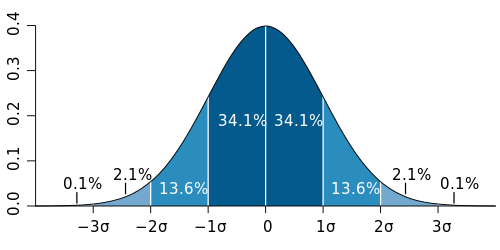
It's role in addiction is best understood in view of the genetic variations that exist between people which is believed to result in a chronic deficiency. All individuals that fall below the normal distribution of a standard bell curve would in all probability be oxytocin deficient, and therefore be prone to addictive behaviour. Behaviour that made the Boomtown Rats song famous for asking why we hate Monday's.


Because 5 day work weeks aren't nice, that's why!


Dark blue is less than one standard deviation from the mean. For the normal distribution, this accounts for about 68% of the set, while two standard deviations from the mean (medium and dark blue) account for about 95%, and three standard deviations (light, medium, and dark blue) account for about 99.7%